Leave Your Message

What Is an MCB Breaker and How Does It Work?

An Mcb Breaker, or miniature circuit breaker, protects electrical circuits from excessive current. It is commonly installed in residential panels, offices, workshops, and small commercial systems. When a circuit draws too much power, the breaker disconnects the supply before wires become dangerously hot. That simple action can prevent equipment damage and reduce fire risks.

Understanding its operation requires looking inside the device. A thermal element responds to sustained overloads, such as too many appliances running through one circuit. A magnetic mechanism reacts almost instantly to a short circuit. These two protections work together. The breaker then moves its contacts apart and stops the current flow. You may hear a sharp click.

A qualified electrician usually checks the circuit rating, cable size, fault level, and installation environment before selecting an Mcb Breaker. The correct ampere rating matters. A higher rating is not automatically safer. It may allow a cable to overheat before the breaker operates. This is where casual replacements often go wrong. Even experienced users can overlook loose terminals, moisture, or an aging distribution board.

This guide explains how an Mcb Breaker works, what its trip characteristics mean, and how to recognize common operating conditions. It also distinguishes a normal reset from a warning sign that needs professional inspection. Breakers are reliable, but they are not maintenance-free. Never treat repeated tripping as a nuisance. It may indicate overload, damaged insulation, or a deeper electrical fault. Local codes and manufacturer instructions should always guide installation and testing.

What Is an MCB Breaker and How Does It Work?

Definition and Purpose of an MCB Breaker

What Is an MCB Breaker and How Does It Work?

Definition and Purpose of an MCB Breaker

A miniature circuit breaker, or MCB, is an automatic safety switch. It protects low-voltage circuits from overloads and short circuits. When current rises beyond a safe level, the device opens the circuit. This action stops electricity before wires become dangerously hot.

An MCB usually uses two release mechanisms. A thermal element responds to sustained overloads, such as too many appliances on one circuit. A magnetic element reacts almost instantly to a short circuit. The International Electrotechnical Commission’s IEC 60898-1 standard defines key requirements for household and similar circuit breakers, including operating performance and short-circuit protection.

The purpose is practical.

It protects cables first.

It also reduces equipment damage and fire risk. The National Fire Protection Association reported an estimated 32,410 U.S. home structure fires involving electrical distribution and lighting equipment from 2016 to 2020. These fires caused approximately 470 civilian deaths, 1,100 injuries, and 1.3 billion dollars in property damage. This figure does not mean MCBs can prevent every electrical fire. Faulty installation, loose connections, and damaged insulation can remain dangerous.

After tripping, an MCB can usually be reset once the fault is removed. Repeated tripping needs investigation, not repeated resetting. In practice, people sometimes treat the breaker as the problem. That assumption deserves reconsideration. Correct rating selection, cable sizing, and professional testing matter just as much as the breaker itself.

Main Components Inside an MCB

What Is an MCB Breaker and How Does It Work?

Main Components Inside an MCB

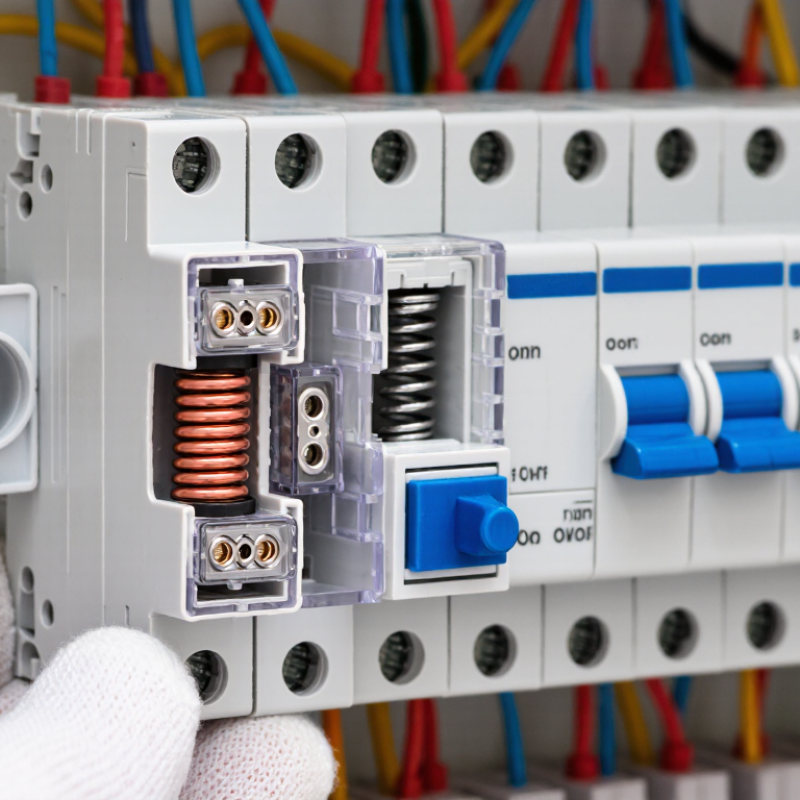
An MCB, or miniature circuit breaker, protects a circuit from overloads and short circuits. Its compact case contains several coordinated parts. The fixed and moving contacts carry normal current. A spring-loaded mechanism opens them when a fault appears. The operating handle then shows whether the circuit is on or tripped.

The thermal element usually uses a bimetal strip. Excess current heats the strip and bends it gradually. This action releases the latch during a sustained overload. The magnetic element reacts faster. A high fault current energizes its coil and pulls a plunger, opening the contacts almost instantly. An arc chute divides and cools the electrical arc. That small chamber matters greatly. Without it, contact damage and heat could continue after disconnection.

IEC 60898-1 covers household MCBs up to 125 amperes and short-circuit capacities up to 25,000 amperes. Actual protection depends on the selected trip curve, cable size, and installation conditions. The IEA’s Electricity 2024 report recorded global electricity demand growth of about 4% in 2024. More demand can increase circuit stress, especially in crowded distribution boards. A common field mistake is treating the handle as the protection itself. It only operates the mechanism. Testing and inspection remain essential. The design is reliable, but not foolproof. Loose terminals, heat, or incorrect ratings can defeat good internal engineering.

What Is an MCB Breaker and How Does It Work? - Main Components Inside an MCB

Component or Feature Construction or Typical Specification Primary Function How It Works During a Fault
Insulated Housing Heat-resistant, electrically insulating molded enclosure Protects internal parts and prevents accidental contact with live electrical components Contains heat, mechanical movement, and the arc produced when the contacts open
Line and Load Terminals Metal connection points secured by terminal screws or clamps Connects the MCB to the incoming supply and outgoing circuit conductors Maintains a firm electrical connection while the breaker carries normal load current
Fixed Contact Stationary conductive contact, commonly made from an engineered copper-based contact material Provides one half of the main current path Separates from the moving contact when the trip mechanism operates, interrupting current flow
Moving Contact Spring-loaded conductive contact linked to the operating mechanism Opens or closes the circuit during switching and tripping Moves rapidly away from the fixed contact to disconnect the circuit during an overload or short circuit
Thermal Trip Element Bimetallic strip formed from two metals with different expansion rates Detects sustained overcurrent, such as an overload Excess current heats and bends the bimetallic strip. After a time delay, it releases the trip mechanism
Magnetic Trip Element Electromagnetic coil with a movable plunger or armature Detects very high current caused by a short circuit The strong magnetic field pulls the plunger almost instantly, releasing the mechanism and opening the contacts
Trip Mechanism Mechanical latch, lever, and spring assembly Converts a thermal or magnetic trip signal into contact separation Releases stored spring energy so the contacts open quickly and independently of the handle position
Operating Handle Manual ON, OFF, and reset control Allows the user to energize, isolate, or reset the circuit After the fault is cleared, the handle can be moved to the reset position and then switched on again
Arc Chute Stack of insulated metal plates or arc-splitting elements Controls and extinguishes the electrical arc formed as the contacts separate Divides and cools the arc, increasing its length until it can no longer sustain current
Arc Runners Conductive guides positioned near the contacts and arc chute Directs the arc away from the contact surfaces Uses electromagnetic forces generated by fault current to move the arc into the arc chute
Operating Spring Preloaded mechanical spring connected to the contact mechanism Provides rapid contact movement during switching and tripping Releases stored energy to open the contacts quickly, helping limit fault duration
Trip Indicator Mechanical position indicator or handle position marker Shows whether the breaker is ON, OFF, or tripped Helps distinguish a fault trip from a manually switched-off condition, depending on the design
Rated Current Continuous current value the MCB is designed to carry under specified conditions Defines the circuit's normal operating current limit If current remains above the rated level, the thermal element eventually trips the breaker
Number of Poles Single-pole, double-pole, three-pole, or four-pole configurations are commonly available Determines how many circuit conductors are switched and protected All connected poles operate through a linked mechanism so the required conductors disconnect together
Tripping Characteristic Common curves include B, C, and D, each with a different instantaneous magnetic-trip range Matches the breaker to the expected inrush current of the connected load The magnetic element trips at a current range determined by the selected characteristic, while overload protection remains time-dependent
Operating principle: An MCB combines thermal protection for prolonged overloads with magnetic protection for high-current short circuits. It can be reset after the fault has been located and corrected.

How an MCB Detects and Stops Electrical Faults

What Is an MCB Breaker and How Does It Work?

How an MCB Detects and Stops Electrical Faults

An MCB, or miniature circuit breaker, protects one electrical circuit from dangerous overcurrent. It replaces a fuse and can be reset after tripping. Inside, a thermal strip responds to prolonged overloads. For example, several heaters may draw more current than the cable can safely carry. The strip heats, bends, and releases the switching mechanism. This delay allows short startup currents without unnecessary trips.

Short circuits require a faster response. A strong fault current creates a magnetic field inside the MCB. That field moves an internal plunger and opens the contacts almost immediately. The contacts separate, and an arc-control chamber helps extinguish the electrical arc. Power stops before excessive heat damages the wiring.

The trip is quick.

An MCB does not detect every electrical danger. It mainly responds to excess current, not small leakage through a person. An RCD or RCBO may provide additional protection against earth leakage, depending on the installation. During a panel inspection, repeated tripping should never be ignored. It may indicate a damaged appliance, loose connection, or overloaded circuit. Simply resetting the lever can hide the real problem. The exact trip time depends on the fault current and breaker characteristics, so assumptions can be misleading. A qualified electrician should test the circuit, identify the cause, and verify that the MCB rating matches the cable size.

Types and Operating Characteristics of MCB Breakers

What Is an MCB Breaker and How Does It Work?

Types and Operating Characteristics of MCB Breakers

An MCB, or miniature circuit breaker, protects low-voltage circuits from overloads and short circuits. It combines thermal and magnetic tripping inside a compact enclosure. The thermal element responds to sustained excess current. A bimetal strip heats, bends, and releases the mechanism. The magnetic element reacts almost instantly to a severe fault. This action opens the contacts and limits damage to cables and equipment.

MCBs differ by pole arrangement, rated current, breaking capacity, and trip curve. Single-pole units protect one live conductor, while two-pole units disconnect live and neutral together. Three-pole and four-pole versions serve multi-phase installations. Type B devices usually trip at lower fault multiples, making them suitable for lighting and general socket circuits. Type C tolerates higher starting currents from motors and transformers. Type D allows even greater inrush, but requires stronger fault conditions and careful verification.

Operating characteristics depend on more than the printed rating. Ambient temperature, cable size, installation method, and circuit length all influence performance. A 16-ampere MCB does not make an undersized cable safe. That mistake is common. In field inspections, loose terminals also create heat before the breaker reaches its trip threshold. Selection should follow measured load data, manufacturer specifications, and applicable electrical standards. The trip curve is useful, but it cannot replace fault-current testing or professional judgment. Even experienced installers should recheck assumptions when equipment starts repeatedly or loads change.

Selecting, Installing, and Maintaining an MCB Safely

An MCB, or miniature circuit breaker, protects a circuit from excessive current. It trips when heat or magnetic force detects an overload or short circuit. Unlike a fuse, it can be reset after the fault is corrected. Selecting one safely requires more than matching the voltage. Check the circuit’s design current, cable size, number of poles, and breaking capacity. The trip curve also matters because motors and lighting can create brief starting surges. Always follow local electrical codes and the equipment manufacturer’s instructions.

Installation begins with isolation, not guesswork. A qualified electrician should disconnect the supply, lock it where possible, and verify that the circuit is dead with a suitable tester. The MCB must fit the distribution board and connect to the correct terminals. Loose conductors can create heat, so terminal torque deserves careful attention. Keep wiring neat, but do not force conductors into a crowded enclosure. A tidy panel can still hide a dangerous mistake.

Maintenance should include visual checks for discoloration, melted insulation, unusual smells, or repeated tripping. Do not keep resetting an MCB without finding the cause. Test the installation according to local requirements and the manufacturer’s guidance. Avoid spraying cleaner inside the panel. Record faults and repairs, even small ones. I have found that overlooked labels often slow emergency work, so clear circuit identification is worth the extra minute. If an MCB feels hot, trips immediately, or will not reset, isolate the circuit and arrange professional inspection.