How to Choose the Right MCCB Breaker for Your Needs?
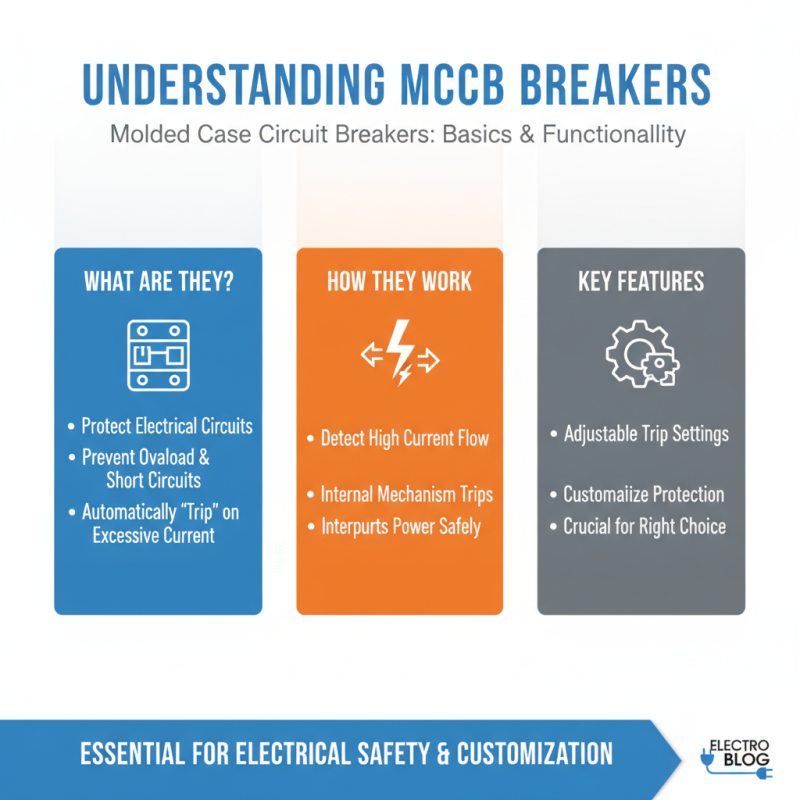
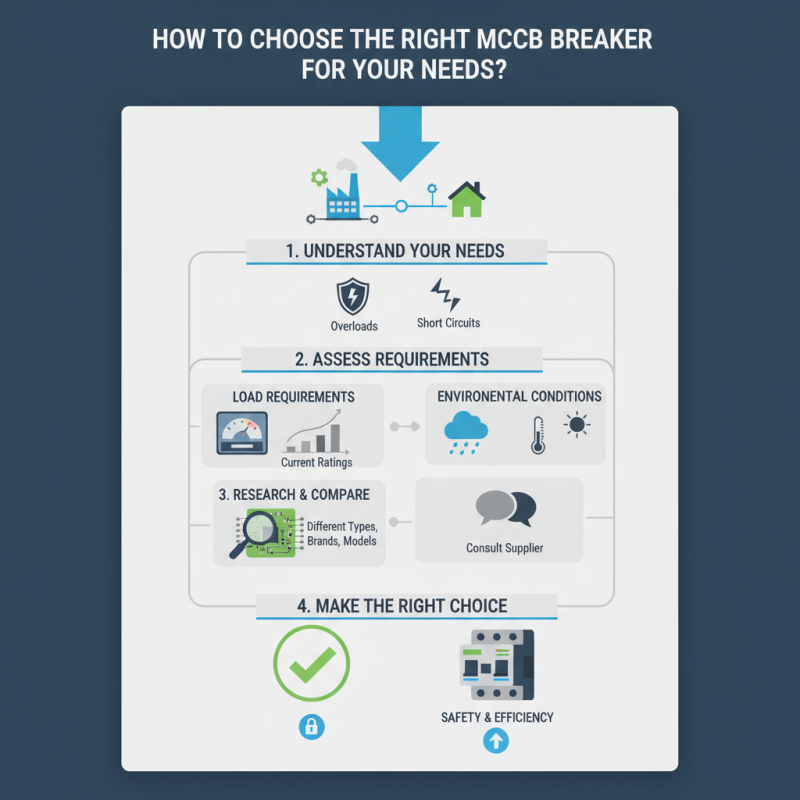
Choosing the right MCCB breaker is crucial for the safety and efficiency of your electrical systems. An MCCB breaker, or molded case circuit breaker, protects electrical circuits from overloads and short circuits. Understanding your specific needs is essential. Different applications require different features.
Selection involves assessing the load requirements and environmental conditions. You may also need a breaker with specific current ratings. It's easy to overlook details when choosing an MCCB breaker. The wrong choice can lead to inefficiencies or hazards in your system.
Educating yourself about the various types available can be overwhelming. There are multiple brands and models on the market. Each offers unique specifications that claim to meet your needs. Taking the time to research and understand these differences will pay off. Your trusted electrical supplier can also provide guidance. Remember, the goal is to find the most reliable and suitable MCCB breaker for your situation.
Understanding the Basics of MCCB Breakers and Their Functionality
MCCB breakers, or molded case circuit breakers, are essential in protecting electrical circuits. They prevent overload or short circuits by tripping when excessive current flows. Understanding their functionality is crucial for choosing the right one. They come with adjustable trip settings, allowing customization based on specific requirements.
Selection involves considering several key factors. First, the voltage and current ratings are critical. You should match these with your system's specifications. Secondly, think about the environment. A breaker used in a damp location may require additional protection. Additionally, consider the interrupting capacity. This detail defines how much fault current the breaker can handle before tripping.
Many users overlook their needs. Some may choose a breaker based solely on price. This approach can lead to future issues. Properly assessing your requirements prevents potential hazards. Relying on expert opinions and technical specifications can guide better choices. Balancing cost and quality is essential for reliability in the long run.
Key Factors to Consider When Selecting an MCCB Breaker
Choosing the right MCCB (Molded Case Circuit Breaker) is essential for electrical safety and equipment longevity. When selecting an MCCB, consider the load current rating. This rating should match the needs of your applications. If the breaker is underrated, it may trip frequently; if overrated, it may not protect adequately.
The breaking capacity is another crucial factor. This refers to the maximum fault current the breaker can interrupt safely. Higher capacities provide better protection against short circuits. Think about the potential short-circuit current in your system. It's vital to calculate this before making a choice.
Tips: Always consult with an electrician when in doubt. They can help evaluate your specific requirements. Additionally, remember that regular maintenance checks can reveal if your chosen MCCB is performing well. Don't overlook this aspect; it can save you from future issues. Consider how environmental conditions might affect performance, too. An MCCB exposed to high humidity or dust may not function optimally. Always aim for the right balance between load capacity, breaking capacity, and environmental adaptability.
Evaluating Voltage and Current Ratings for Your Application
Choosing the right MCCB (Molded Case Circuit Breaker) starts with understanding your voltage and current needs. Voltage ratings determine the maximum voltage the breaker can handle. Most MCCBs operate within standard voltages of 400V to 690V, but specific applications may require tailored solutions. For instance, industrial settings often demand breakers rated above 600V due to increased machinery requirements.
Current ratings indicate how much electrical current the breaker can safely carry without tripping. The National Electrical Manufacturers Association (NEMA) suggests selecting a breaker whose current rating exceeds the expected load by 25%. A typical MCCB is rated anywhere from 15A to 3,200A. If your application often peaks at higher currents, a higher-rated MCCB is essential.
Failure to match these specifications can lead to frequent trips and operational inefficiencies. Many users reportedly underestimate the importance of these ratings. According to a 2022 report by the International Electrotechnical Commission (IEC), incorrect sizing of MCCBs remains a common issue, with nearly 30% of users experiencing unnecessary outages. This highlights the need for diligence in evaluating both voltage and current ratings for reliable, efficient operation.
How to Choose the Right MCCB Breaker for Your Needs? - Evaluating Voltage and Current Ratings for Your Application
| Parameter |
Description |
Example Values |
| Voltage Rating |
The maximum voltage that the MCCB can handle without breaking down. |
230V, 400V, 690V |
| Current Rating |
The maximum load current the MCCB can safely carry. |
16A, 32A, 63A, 125A |
| Breaking Capacity |
The maximum fault current that the breaker can interrupt. |
10kA, 25kA, 50kA |
| Mounting Type |
How the MCCB is installed in a panel or system. |
DIN Rail, Panel Mount |
| Trip Types |
Types of trip mechanisms available in the MCCB. |
Thermal, Magnetic, Electronic |
| Environment Type |
The operating environment the MCCB is designed for. |
Indoor, Outdoor, Humid |
Assessing the Environment and Installation Conditions for MCCBs
When selecting an MCCB (Molded Case Circuit Breaker), installation conditions play a vital role.
The environment where the MCCB will be installed, such as indoor versus outdoor settings, directly impacts its performance.
For instance, outdoor breakers need to withstand moisture and temperature fluctuations.
Choose components that meet environmental standards for longevity.
Temperature is another critical factor.
High ambient temperatures can affect the breaker’s trip characteristics.
An MCCB installed in a hot area might trip more frequently.
Consider the temperature range of your installation site. If unsure, consult technical data sheets for detailed specifications.
Finally, assess physical space requirements.
MCCBs come in various sizes, and placement must allow for access and ventilation.
A cramped installation can impede maintenance.
It's essential to create a balance between accessibility and safety.
Taking time to evaluate these conditions can prevent future electrical issues.
Comparing Different Brands and Models of MCCBs in the Market
Choosing the right Molded Case Circuit Breaker (MCCB) involves careful consideration of various brands and models available in the market. Reports indicate that the electrical industry expects a growth rate of around 6.2% annually in MCCB demand. This reflects increasing energy efficiency needs across sectors. A suitable MCCB balances current ratings, interrupting capacity, and physical dimensions.
When comparing different MCCBs, focus on their specifications. Look at their thermal and magnetic trip settings, which influence operational reliability. Some MCCBs offer advanced features, such as digital monitoring. These can improve operational analysis. However, they can also add complexity. You might not need these advanced functions for simple applications.
Tips: Always check for certification marks to ensure reliability. Performance tests can offer insight into product longevity. Consider your specific load requirements carefully, as improper selection can lead to frequent tripping. A mismatch here often leads users to reconsider their choices, especially regarding maintenance and repair costs. Seek advice from experts when uncertain about specifications.
Comparison of MCCB Breakers Based on Trip Current Ratings
This chart illustrates the comparison of different MCCB breakers based on their trip current ratings. The data represents the average trip current ratings in amperes for various models.